
Mission
To support female engineers and architects in their comprehensive professional development by encouraging their participation in the work of the CFIA and its member associations, in accordance with ethical and humanistic values and for the benefit of Costa Rican society.
Vision
To establish a platform for support and the promotion of participation and engagement through mechanisms that foster relevant strategies designed to promote the comprehensive development and professional advancement of female engineers and architects, thereby supporting the fulfillment of their rights and responsibilities.
Create a space for ongoing participation by our female engineers and architects within the CFIA, both in projects in their respective professional areas and in decision-making processes within the CFIA.
- Provide support in terms of training and logistics for the various projects presented by CFIA professionals.
- Foster exchanges with various public and/or private organizations focused on professional development.
- To encourage our colleagues to become more involved in the work of the CFIA and its respective assemblies, boards of directors, committees, and associations.
- To promote exchanges and participation in eventos , as well as comprehensive, ongoing professional training and development for our colleagues.
- Carry out an annual systematization and monitoring of the activities carried out by female engineers and architects involved in various national and international spaces and projects, both in the public and private sectors.
- There has been a significant increase in the number of female architects and engineers since the 1990s.
- There are mechanisms that need to be strengthened and created to improve the participation and effective involvement of our female engineers and architects in CFIA activities and in the achievement of its goals.
- The Joint Gender Commission is one of the tools available to the CFIA to promote the presence and participation of female engineers and architects in our country’s overall development.
- The CFIA must serve as an effective advocate and watchdog for rights and responsibilities regarding gender equality in the practice of our professions.
In recent years, there has been a significant increase in the number of female engineers and architects joining the CFIA, as shown in the following graph, where the significant increase began in the 1990s:
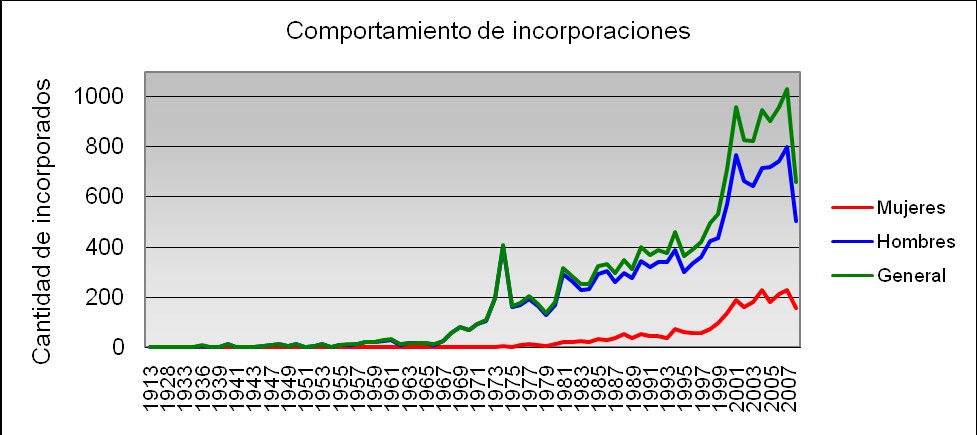
Given this increase in the number of professional women at the CFIA, it is necessary to have effective mechanisms for their participation and involvement in the general and specific activities for which the Association is responsible.
Having a Joint Gender Commission (or a Commission for Women Engineers and Architects) enables the CFIA, through the development of projects and programs, to promote these initiatives and contribute to the development and improvement of the quality of life for both its members and our society.
The CFIA must take a leading role in the area of gender participation among its members, given the importance of their presence in positions of power and decision-making at the national level; this justifies strengthening and promoting their participation and development in consultative bodies and forums that have a real impact on the practice of engineering and architecture. In this regard, the Joint Gender Commission (or Commission for Women Engineers and Architects) will serve as the CFIA’s tool for involving both women engineers and women architects in its mission and offering them a real opportunity to achieve their personal and professional goals and objectives.
The current situation at the College of Engineers and Architects is illustrated in the chart presented in the previous section, which shows a significant increase in the number of women joining the College in recent years. This highlights the importance of participation and the promotion of gender equality within the College.
In accordance with Law No. 71421 on the Promotion of Substantive Equality for Women, assist the CFIA in creating mechanisms that facilitate women professionals’ participation in leadership and representative positions within the Association.
Members
CIC
Hazel Alpízar Vindas, Engineer
Grethel Morales Benavides, Engineer
CACR
Deborah Picado Campos, Architect
CIEMI
Kattia Ruiz Fuentes, Engineer
Alexandra Arias Alvarado, Engineer
CIT
Álvaro Fuentes García, Engineer
Joselyn Barboza Madrigal, Engineer
CITEC
Dinia Vega Díaz, Engineer
Daniela Jiménez Escudé, Engineer
Diana Carolina Calvo Chacón, Engineer
Karen Badilla Salazar, Engineer.
CFIA
Andrea Peña González, Engineer
For more information, please contact the Committees, Commissions, and Representations Unit (UNCORE).


